
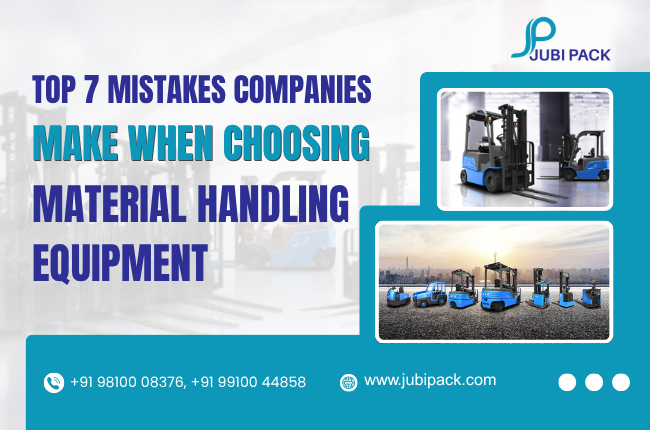
Top 7 Mistakes Companies Make When Choosing Material Handling Equipment
Selecting the right material handling equipment is a critical decision for any business involved in warehousing, manufacturing, or logistics. The right choice can significantly improve efficiency, reduce operational costs, and enhance workplace safety. However, many companies make costly mistakes during the selection process, leading to inefficiencies, increased downtime, and unnecessary expenses.
Jubipack understands these challenges and helps businesses make informed decisions by offering advanced and reliable solutions tailored to modern industrial needs.
In this comprehensive guide, we explore the top 7 mistakes companies make when choosing material handling equipment and how to avoid them.
1. Ignoring Actual Operational Requirements
One of the most common mistakes is selecting equipment without fully understanding operational needs. Many businesses choose machines based on assumptions rather than real data.
For example, a warehouse may invest in heavy material handling equipment when lighter, more agile machines would be more efficient. Similarly, failing to consider load size, movement frequency, and workflow can lead to poor performance.
How to Avoid:
- Conduct a detailed operational analysis
- Evaluate load types, weights, and movement patterns
- Choose equipment that aligns with daily tasks
2. Choosing the Wrong Type of Material Handling Equipment
With so many types of material handling equipment available, selecting the wrong one is easy. Businesses often confuse industrial trucks, bulk material handling equipment, and automated systems.
Using the wrong equipment can slow down operations and increase wear and tear.
How to Avoid:
- Understand different categories:
- Industrial material handling equipment (forklifts, pallet trucks)
- Bulk material handling equipment (conveyors, stackers)
- Storage systems (racks, shelves)
- Match equipment to the application
3. Overlooking Warehouse Layout and Space Constraints
Many companies fail to consider their warehouse layout when choosing equipment. Large machines in compact spaces can cause congestion and reduce efficiency.
Material handling equipment in warehouse environments must be compatible with aisle width, storage design, and movement flow.
How to Avoid:
- Analyze warehouse layout before purchase
- Choose compact or specialized equipment for tight spaces
- Optimize movement paths
4. Focusing Only on Initial Cost
Cost is important, but focusing only on the purchase price is a major mistake. Cheaper equipment often results in higher maintenance costs, lower efficiency, and shorter lifespan.
This is especially true when comparing traditional machines with modern lithium-powered equipment.
How to Avoid:
- Evaluate total cost of ownership (TCO)
- Consider maintenance, energy consumption, and lifespan
- Invest in long-term value rather than short-term savings
5. Ignoring Maintenance and Service Support
Material handling equipment requires regular maintenance to perform efficiently. Many companies overlook service availability, spare parts, and technical support.
This leads to increased downtime and operational disruption.
How to Avoid:
- Choose reliable material handling equipment suppliers
- Ensure availability of spare parts and service support
- Plan preventive maintenance schedules
6. Not Considering Future Scalability
Businesses often choose equipment based only on current needs, ignoring future growth. As operations expand, existing equipment may become insufficient.
This results in additional costs and operational inefficiencies.
How to Avoid:
- Plan for future expansion
- Choose scalable and adaptable equipment
- Invest in flexible solutions that grow with your business
7. Neglecting Safety and Compliance
Safety is a crucial factor in any warehouse or industrial environment. Ignoring safety features or compliance standards can lead to accidents, legal issues, and financial losses.
Heavy material handling equipment must meet safety regulations and be operated by trained personnel.
How to Avoid:
- Ensure equipment meets safety standards
- Provide operator training
- Implement safety protocols and regular inspections
The Role of the Right Equipment in Business Success
Choosing the right material handling equipment is not just about machinery—it directly impacts productivity, cost efficiency, and workplace safety. From warehouse material handling equipment to industrial applications, the right decision can transform operations.
Companies that invest in modern, efficient, and reliable equipment gain a competitive advantage in today’s fast-paced industrial environment.
Why Work with Jubipack?
Jubipack provides advanced solutions designed to meet the evolving needs of modern businesses. With expertise in lithium battery-powered forklifts and warehouse equipment, the company helps clients avoid common mistakes and select the most suitable solutions.
Key advantages include:
- High-performance and energy-efficient equipment
- Expert guidance and consultation
- Reliable service and support
- Solutions tailored to warehouse and industrial needs
Conclusion
Avoiding these common mistakes can save businesses significant time, money, and operational challenges. By understanding requirements, evaluating long-term value, and prioritizing safety and scalability, companies can make smarter decisions when selecting material handling equipment.
Whether you are upgrading your warehouse or setting up a new facility, choosing the right equipment is a crucial step toward achieving efficiency and long-term success.