
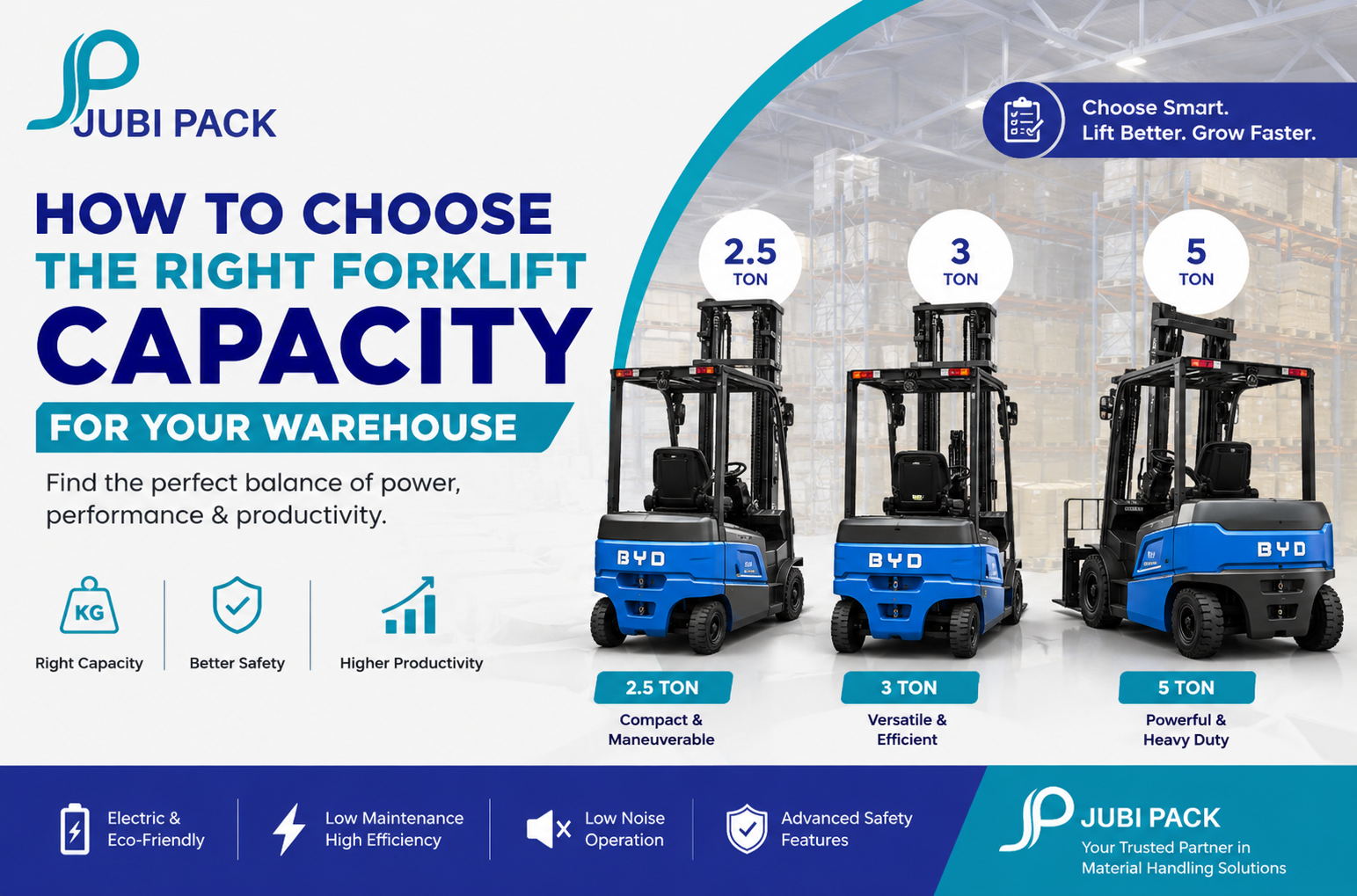
How To Choose The Right Forklift Capacity For Your Warehouse
Selecting the right forklift capacity is one of the most important decisions for any warehouse, manufacturing plant, logistics center, or distribution facility. A forklift that is too small may struggle with heavy loads, reducing productivity and creating safety risks. On the other hand, choosing a forklift with a higher capacity than required can increase operating costs and reduce efficiency.
With the rapid growth of e-commerce, manufacturing, and warehousing in India, businesses are investing in advanced material handling equipment that delivers better productivity and lower operational costs. Modern electric forklifts, especially lithium battery models, are becoming the preferred choice due to their energy efficiency, low maintenance, and zero-emission operation.
This guide explains how to choose the right forklift capacity, compares 2.5 ton forklifts, 3 ton forklifts, and 5 ton forklifts, and helps you select the best solution for your warehouse.
What Does Forklift Capacity Mean?
Forklift capacity refers to the maximum weight a forklift can safely lift at a specified load center. Manufacturers typically rate forklifts at a 500 mm load center, meaning the weight should be evenly distributed.
However, actual lifting capacity depends on several factors:
- Load dimensions
- Load center distance
- Lift height
- Fork attachment type
- Warehouse floor condition
- Counterweight balance
Understanding these factors helps businesses avoid overloading, equipment damage, and workplace accidents.
Why Choosing the Correct Forklift Capacity Matters
Choosing the correct warehouse forklift selection is about much more than lifting heavy loads.
A properly sized forklift provides:
- Higher warehouse productivity
- Better operator safety
- Lower maintenance costs
- Reduced energy consumption
- Longer equipment life
- Improved material handling efficiency
Using oversized forklifts for light loads increases purchase and operating costs, while undersized forklifts create safety hazards and reduce operational efficiency.
Understanding Different Forklift Capacities
2.5 Ton Forklift
A 2.5 ton forklift is among the most popular choices for Indian warehouses.
It is suitable for:
- Retail distribution centers
- FMCG warehouses
- Packaging industries
- Pharmaceutical companies
- Cold storage facilities
- Small manufacturing units
Advantages
- Compact design
- Easy maneuverability
- Lower electricity consumption
- Suitable for narrow aisles
- Lower operating cost
Businesses handling pallets between 1,000 kg and 2,500 kg usually find a 2.5 ton forklift sufficient for daily operations.
3 Ton Forklift
The 3 ton forklift offers the ideal balance between lifting capacity and versatility.
It is commonly used in:
- Automotive manufacturing
- Logistics hubs
- Engineering industries
- Large warehouses
- Heavy packaging plants
Benefits
- Handles heavier pallet loads
- Excellent stability
- Faster loading operations
- Suitable for indoor and outdoor use
- Greater lifting flexibility
A 3 ton forklift is an excellent option for businesses expecting future growth without immediately investing in larger equipment.
5 Ton Forklift
When operations involve oversized or heavy industrial materials, a 5 ton forklift becomes the preferred choice.
Industries include:
- Steel plants
- Cement factories
- Ports
- Construction material yards
- Heavy engineering
- Industrial manufacturing
Key Benefits
- High lifting power
- Excellent structural stability
- Heavy-duty chassis
- Handles oversized pallets
- Suitable for continuous operations
Although the initial investment is higher, a 5 ton forklift provides unmatched performance for demanding industrial environments.
Factors to Consider Before Choosing Forklift Capacity
1. Maximum Load Weight
Always determine the heaviest pallet or material handled daily.
Choose a forklift with slightly higher capacity than your average load to maintain safety and operational flexibility.
2. Lift Height
Many warehouse managers overlook lift height.
As lifting height increases, actual lifting capacity decreases.
If your warehouse uses high racking systems, consult the forklift load chart before purchasing.
3. Warehouse Layout
Warehouse design significantly affects forklift selection.
Consider:
- Aisle width
- Door clearance
- Rack spacing
- Loading dock dimensions
- Turning radius
Compact electric forklifts perform exceptionally well in narrow warehouse aisles.
4. Indoor or Outdoor Operation
Indoor warehouses benefit greatly from lithium battery forklifts because they produce:
- Zero emissions
- Ultra-low noise
- Lower heat generation
- Better air quality
Outdoor operations with rough terrain may require larger pneumatic-tire forklifts depending on working conditions.
5. Frequency of Operations
Businesses operating multiple shifts should prioritize electric lithium forklifts with opportunity charging.
Fast charging minimizes downtime while improving productivity throughout the day.
Electric Forklifts vs Diesel Forklifts
Modern warehouses increasingly prefer electric forklifts over diesel models.
Electric Forklifts
- Zero emissions
- Low maintenance
- Silent operation
- Lower operating costs
- Fast lithium charging
- Better indoor safety
Diesel Forklifts
- Higher fuel expenses
- Engine maintenance
- Noise pollution
- Carbon emissions
- More vibration
As sustainability becomes a business priority, electric forklifts continue to dominate the future of warehouse material handling.
Common Mistakes When Choosing Forklift Capacity
Many businesses make costly purchasing mistakes.
Avoid these common errors:
- Buying based only on price
- Ignoring future warehouse expansion
- Underestimating load weight
- Choosing oversized forklifts unnecessarily
- Ignoring battery technology
- Not considering aisle dimensions
- Forgetting operator comfort
- Overlooking maintenance costs
Proper planning prevents unnecessary investment and improves long-term productivity.
Why Lithium Battery Forklifts Are Becoming the Preferred Choice
Lithium battery forklifts have transformed the material handling industry.
Their advantages include:
- Opportunity charging
- Long battery life
- Zero battery maintenance
- High energy efficiency
- Consistent power output
- Lower total ownership cost
- Environmentally friendly operation
Unlike lead-acid batteries, lithium batteries require no water refilling or cooling periods, making them ideal for busy warehouses.
Recommended Forklift Capacity by Industry
Warehousing & Logistics
Recommended: 2.5 Ton Forklift
Retail Distribution
Recommended: 2.5 Ton Forklift
Food & Beverage
Recommended: 2.5 Ton Forklift
Pharmaceutical Industry
Recommended: 2.5 Ton Forklift
Manufacturing Plants
Recommended: 3 Ton Forklift
Automotive Industry
Recommended: 3 Ton Forklift
Heavy Engineering
Recommended: 5 Ton Forklift
Steel & Construction
Recommended: 5 Ton Forklift
Choosing the right capacity based on industry requirements ensures maximum return on investment and operational efficiency.
Future Trends in Warehouse Material Handling
Warehouse automation and smart logistics are reshaping the industry.
Emerging trends include:
- Lithium battery forklifts
- Smart fleet management
- IoT-enabled forklifts
- Predictive maintenance
- Energy-efficient warehouses
- Electric material handling equipment
- AI-based warehouse optimization
Companies adopting modern electric forklifts today will remain competitive as warehouse technology continues to evolve.
Conclusion
Selecting the correct forklift capacity is essential for improving warehouse safety, productivity, and long-term profitability. Whether your business requires a 2.5 ton forklift for compact warehouse operations, a 3 ton forklift for versatile industrial applications, or a 5 ton forklift for heavy-duty lifting, understanding your operational needs is the first step toward making the right investment.
Modern material handling equipment, especially lithium battery forklifts, offers lower operating costs, faster charging, minimal maintenance, and environmentally friendly performance. By evaluating load weight, lift height, warehouse layout, and future business growth, companies can confidently choose the right forklift solution that delivers maximum efficiency and return on investment.