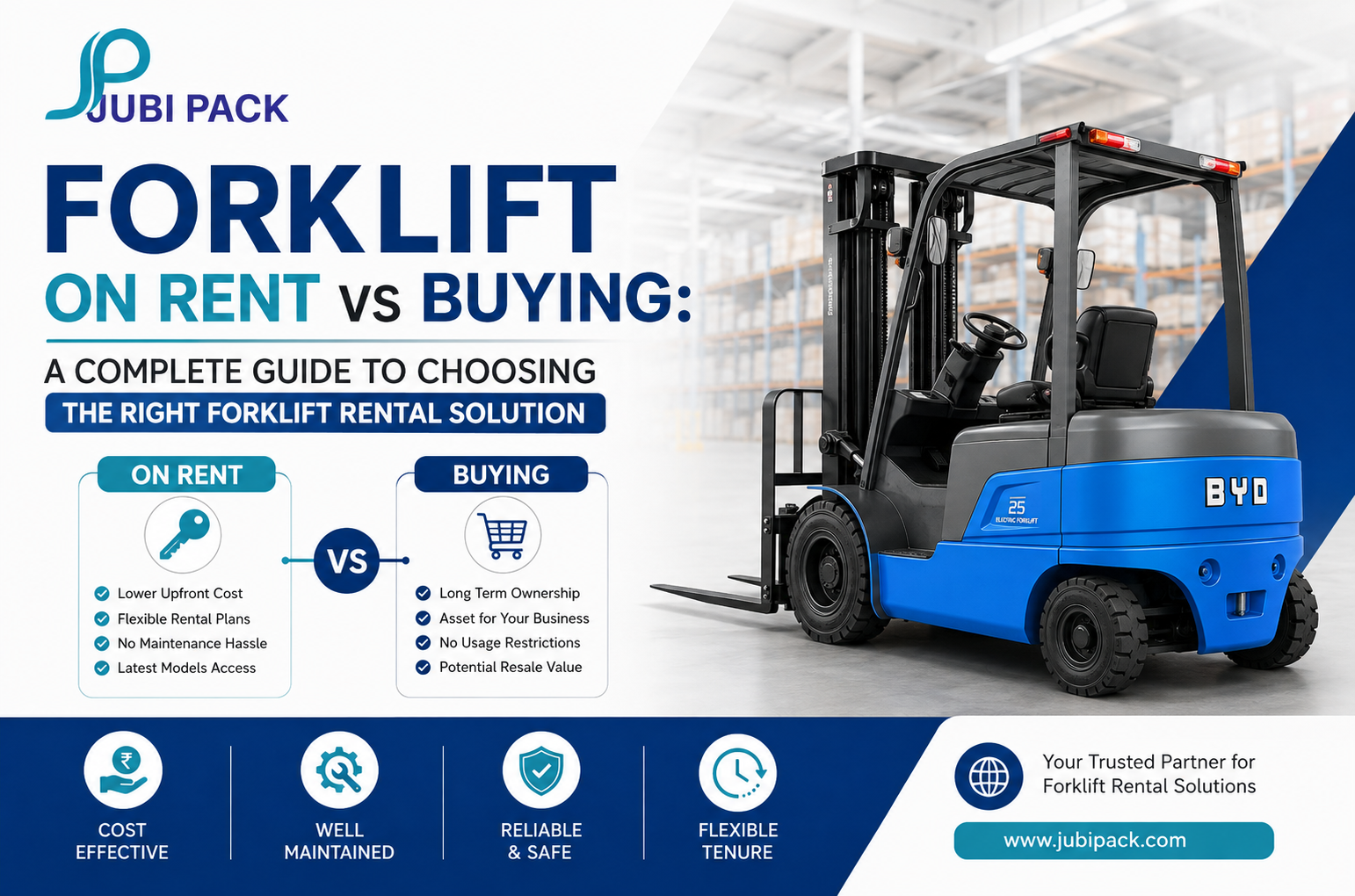
Forklift On Rent Vs Buying: A Complete Guide To Choosing The Right Forklift Rental Solution
Choosing between taking a forklift on rent and purchasing one is an important business decision for warehouses, manufacturing facilities, logistics companies, and distribution centres. Forklifts are essential for moving, lifting, stacking, and transporting materials efficiently. However, buying a forklift requires significant capital investment, while renting provides flexibility and lower upfront costs.
The right choice depends on several factors, including how frequently the equipment is used, the type of materials being handled, available budget, maintenance requirements, and the expected duration of operations. This guide explains the key differences between renting and buying a forklift and helps businesses choose the right forklift rental solution for their operational requirements.
Why Forklifts Are Essential for Material Handling
A forklift is one of the most widely used machines in modern warehouses and industrial facilities. It helps businesses move heavy loads quickly while reducing manual labour and improving workplace efficiency.
Depending on the application, a forklift may be used for:
- Loading and unloading trucks
- Moving pallets within a warehouse
- Stacking goods at different heights
- Transporting raw materials in manufacturing facilities
- Handling heavy and bulky products
- Supporting logistics and distribution operations
A reliable material handling equipment company can help businesses select equipment based on load capacity, lifting height, operating environment, aisle width, and usage requirements.
However, before selecting the right machine, businesses must decide whether a forklift on rent or a purchased forklift offers better long-term value.
Forklift on Rent: Understanding the Benefits
Choosing a forklift on rent can be an effective solution for businesses that need equipment without making a large initial investment. Instead of purchasing the machine outright, the business pays for the equipment for a specific rental period.
This approach is particularly useful for short-term projects, seasonal demand, temporary warehouse expansion, or unexpected increases in material movement.
1. Lower Initial Investment
One of the biggest advantages of choosing a forklift for rent is the lower upfront cost. Purchasing industrial equipment can require substantial capital, especially when advanced electric or battery-powered forklifts are involved.
Rental allows businesses to access the required equipment while preserving capital for other important areas such as inventory, infrastructure, workforce, and business expansion.
2. Flexibility for Changing Requirements
Material handling requirements can change quickly. A warehouse may experience seasonal demand, receive larger shipments, or expand its operations temporarily.
In such situations, forklift rental services provide greater flexibility. Businesses can select equipment according to their current requirements instead of committing to a machine that may become unsuitable in the future.
For example, a company may initially need a standard forklift but later require a reach truck or higher-capacity equipment. Renting makes it easier to adapt to these changing operational needs.
3. Reduced Maintenance Responsibility
Forklifts require regular inspection, servicing, and maintenance to operate safely and efficiently. When a business owns the equipment, it is generally responsible for maintenance planning, repair costs, spare parts, and equipment downtime.
With professional forklift rental services, maintenance support may be included according to the rental agreement. This can reduce unexpected repair expenses and allow businesses to focus more on their core operations.
It is important to review the rental contract carefully to understand who is responsible for scheduled maintenance, emergency repairs, tyres, batteries, and replacement equipment.
4. Access to Suitable Equipment
Different operations require different types of forklifts. A machine suitable for outdoor material movement may not be ideal for narrow warehouse aisles.
A forklift for rent allows businesses to choose equipment based on the specific application. Options may include electric forklifts, battery forklifts, diesel forklifts, high-capacity forklifts, and warehouse-focused machines.
Working with an experienced material handling equipment company can help ensure that the selected forklift matches the actual operating conditions.
When Buying a Forklift Makes Sense
Although rental offers flexibility, purchasing a forklift may be a better option for businesses with consistent and long-term equipment requirements.
If a forklift is used every day for several years, ownership can potentially provide better value over time.
1. Long-Term and Regular Usage
Businesses with continuous warehouse or manufacturing operations may benefit from purchasing equipment. If the forklift is required every day, ongoing rental payments could eventually exceed the long-term cost of ownership.
Before making a decision, businesses should compare the total cost of rental with the purchase price, financing costs, maintenance expenses, insurance, and expected lifespan of the equipment.
2. Greater Control Over Equipment
Ownership provides complete control over the machine. Businesses can schedule maintenance according to their operational needs and retain the equipment for as long as required.
Companies can also select a forklift with customised specifications for their particular application. This may be useful when handling specialised materials or operating in unique industrial environments.
3. Long-Term Asset Value
A purchased forklift becomes a business asset. Although its value depreciates over time, it may still have resale or trade-in value.
For companies with predictable, long-term requirements, ownership can therefore be a practical investment.
Forklift on Rent vs Buying: Key Factors to Consider
Before choosing between renting and buying, businesses should evaluate their complete operational requirements.
Frequency of Use
If the forklift is required occasionally or for a limited project, a forklift on rent may be the more economical option. For continuous daily operations, purchasing may offer better long-term value.
Duration of Requirement
Short-term needs generally favour rental. Long-term and stable requirements may justify ownership.
Budget and Cash Flow
Rental reduces the initial financial burden and helps preserve working capital. Buying requires a larger investment but can reduce dependency on ongoing rental payments.
Maintenance and Downtime
Businesses should consider whether they have the internal resources to maintain forklifts. Equipment maintenance is essential for safety, productivity, and reliability.
Type of Material Handling Application
The forklift should always match the application. Factors such as load weight, lifting height, aisle width, floor conditions, indoor or outdoor use, and operating hours should be considered before selecting equipment.
How to Choose the Right Forklift Rental Solution
When looking for forklift rental services, businesses should not select equipment based only on price. The cheapest rental option may not always provide the right capacity, safety features, maintenance support, or reliability.
Start by clearly defining your operational requirements. Calculate the average and maximum load weight, required lifting height, number of operating hours, and available aisle space.
Next, evaluate the rental provider's equipment availability and support services. A professional material handling equipment company should be able to recommend a suitable machine based on your application rather than simply offering a standard model.
Also ask about:
- Rental duration and pricing structure
- Maintenance and service support
- Equipment replacement during breakdowns
- Operator training requirements
- Safety inspections and documentation
- Battery charging requirements for electric forklifts
- Additional charges and contract conditions
Businesses searching for regional providers may use terms such as forklift rental Johannesburg or similar location-based searches. However, the most important factor is choosing a provider that genuinely serves your operational location and can provide timely service and support.
Final Thoughts
There is no single answer to whether renting or buying is better. A forklift on rent is often ideal for short-term projects, seasonal demand, changing operational requirements, and businesses that want to avoid a large upfront investment.
Buying may be more suitable for companies with stable, long-term, and high-frequency material handling requirements.
The best decision comes from evaluating the total cost of ownership, expected usage, equipment specifications, maintenance responsibilities, and future business needs. By working with a reliable material handling equipment company, businesses can select the right forklift and create a more efficient, productive, and cost-effective material handling operation.