
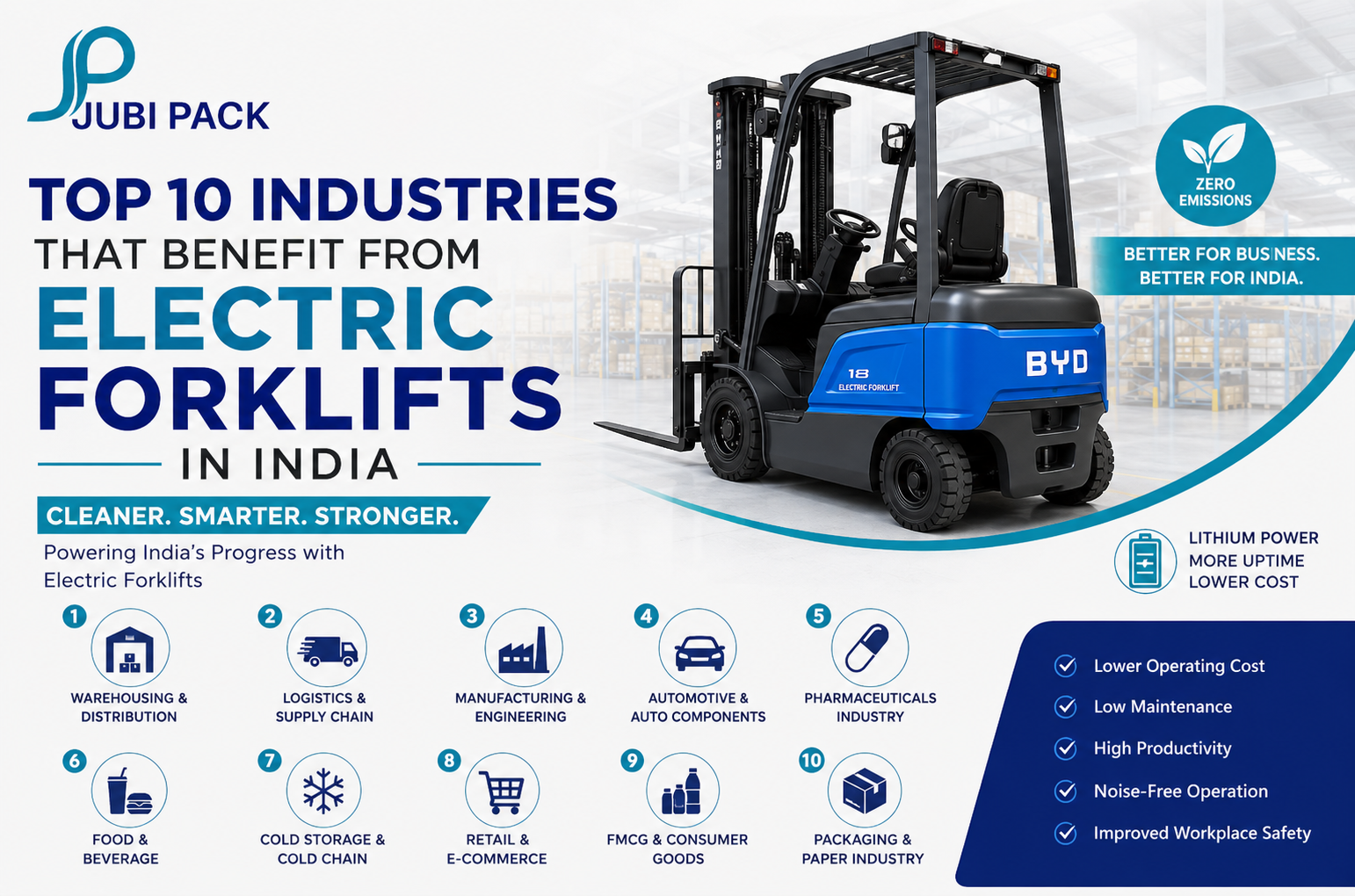
Top 10 Industries That Benefit From Electric Forklifts In India
India’s material-handling landscape is changing rapidly. Warehouses, factories, distribution centres and industrial facilities are increasingly looking for equipment that can deliver reliable performance while controlling energy, maintenance and environmental costs. This is one reason electric forklifts in India are gaining attention across multiple industries.
Unlike conventional diesel forklifts, modern electric forklifts can provide zero tailpipe emissions, low operating noise, smooth control and reduced routine maintenance. Lithium-ion technology has further strengthened the case by enabling faster charging and supporting demanding operational schedules.
Recent industry research indicates that electric forklifts are becoming an important part of India’s forklift market, particularly across warehousing, logistics and manufacturing. Lithium-ion is also emerging as a leading battery technology because of its charging speed, efficiency and lower maintenance requirements.
But which industries benefit the most? Let’s look at the top 10 industries using electric forklifts in India and understand why these machines are becoming valuable material-handling equipment.
Why Are Electric Forklifts Becoming Popular in India?
Before discussing individual industries, it is important to understand what makes electric forklifts attractive.
Modern electric forklifts are particularly suitable for operations where indoor air quality, noise, operating cost and manoeuvrability matter. Lithium-ion models can also support opportunity charging, allowing businesses to recharge during breaks or operational intervals instead of depending entirely on long charging cycles.
The Indian market is seeing strong interest in electric and lithium-ion equipment, with research identifying warehousing, logistics, manufacturing, retail and e-commerce among important application areas.
Key advantages include:
- Zero tailpipe emissions
- Lower routine maintenance requirements
- Reduced operating noise
- Smooth and precise handling
- Fast charging with lithium-ion technology
- Better suitability for indoor operations
- Reduced dependence on fossil fuels
- Improved workplace environment
Now, let’s explore the industries where these advantages can make the biggest difference.
1. Warehousing and Distribution
Warehousing is one of the strongest applications for electric forklifts in India.
Modern warehouses need to move pallets, cartons and inventory continuously while using available floor space efficiently. Electric forklifts are well suited to these environments because they produce no exhaust emissions during operation and generally operate more quietly than internal-combustion equipment.
This is particularly useful in enclosed warehouses where ventilation and workplace comfort are important. Compact electric forklifts can also manoeuvre through relatively narrow aisles, helping businesses optimise storage layouts.
For warehouses operating multiple shifts, a lithium forklift in India can be particularly attractive because opportunity charging can reduce unnecessary downtime.
2. Logistics and Third-Party Logistics
India’s logistics sector is expanding alongside e-commerce, organised retail and increasingly sophisticated supply chains. Logistics facilities need forklifts for loading, unloading, pallet movement, sorting and temporary storage.
Logistics forklifts need to balance productivity with operating costs. Electric models can help provide consistent performance without the fuel consumption and exhaust associated with diesel equipment.
Lithium-ion forklifts are particularly relevant where equipment works for extended periods because fast charging can make fleet scheduling easier.
Industry research also identifies warehousing and logistics as a dominant application area within India's forklift market.
3. Manufacturing and Engineering
Manufacturing plants are another major application for manufacturing forklifts.
Automotive, engineering, machinery and general manufacturing facilities constantly move raw materials, components, finished products and pallets between production areas and storage locations.
Electric forklifts can be useful inside these facilities because they combine lifting capability with low noise and zero tailpipe emissions. This is especially valuable where forklifts operate close to production workers.
For manufacturers looking to improve material flow while supporting sustainability targets, electric material-handling equipment can become an important part of a broader operational strategy.
4. Automotive and Auto-Component Plants
India’s automotive manufacturing ecosystem requires extensive internal material movement. Components may travel between warehouses, assembly lines, quality-control areas and dispatch zones several times a day.
Electric forklifts are well suited to these repetitive indoor applications.
Their smooth acceleration and precise controls can help operators position loads accurately around production equipment. Low noise is another advantage because manufacturing facilities can already be busy and noisy environments.
For high-throughput plants, lithium-ion technology can also support more flexible charging schedules.
5. Pharmaceutical Industry
The pharmaceutical industry has particularly demanding material-handling requirements.
Manufacturing facilities and distribution centres may need to handle raw materials, packaging materials, finished medicines and pallets under controlled conditions. Maintaining a clean working environment is therefore important.
An electric forklift for warehouse applications can be advantageous because it does not produce diesel exhaust emissions during operation.
Electric forklifts can also operate more quietly, making them suitable for facilities where maintaining a controlled workplace environment is important.
6. Food and Beverage Industry
Food and beverage facilities handle ingredients, packaging and finished products throughout production and distribution.
Electric forklifts are particularly useful in indoor food-processing and storage environments because there are no tailpipe emissions. Reduced noise can also improve the working environment.
In addition, electric equipment can support cleaner material-handling processes where businesses want to reduce the possibility of exhaust-related contamination.
For companies operating temperature-controlled areas, the choice of forklift should be based on the specific operating environment, battery requirements, floor conditions and manufacturer recommendations.
7. Cold Storage and Cold Chain Logistics
India’s cold-chain sector requires specialised material-handling solutions. Forklifts may operate inside cold rooms, refrigerated warehouses and distribution facilities where operating conditions can be demanding.
Cold storage forklifts need appropriate configurations for the environment, including suitable battery performance, tyres, operator protection and maintenance practices.
Electric forklifts can be advantageous because indoor facilities benefit from zero tailpipe emissions and low noise. However, businesses should select equipment specifically designed and configured for their temperature conditions rather than assuming every electric forklift is suitable for every cold-storage application.
8. Retail and E-Commerce
Retail distribution centres and e-commerce fulfilment facilities handle huge quantities of products every day.
Speed, manoeuvrability and uptime are crucial. Electric forklifts can support these requirements, particularly in enclosed fulfilment centres where exhaust emissions are undesirable.
Research into India's electric forklift market specifically identifies retail and e-commerce as important end-use segments.
Lithium-ion models can be particularly useful in high-throughput facilities because fast charging and opportunity charging can help reduce interruptions to daily operations.
9. FMCG and Consumer Goods
FMCG warehouses deal with fast-moving products such as packaged foods, beverages, personal-care products and household goods.
These operations typically involve repetitive pallet movement and high inventory turnover. A dependable warehouse equipment India strategy therefore needs to focus on productivity, safety and operating cost.
Electric forklifts can provide the clean and quiet operation needed for indoor distribution centres while supporting frequent material movement.
Their compact designs can also be useful where warehouses are trying to maximise storage density and aisle utilisation.
10. Packaging, Paper and General Industrial Operations
Packaging and paper businesses handle rolls, cartons, pallets, raw materials and finished products. Depending on the application, forklift capacity requirements can range from smaller warehouse models to heavier industrial machines.
Electric forklifts are particularly suitable for indoor movement where emissions and noise are concerns.
For heavier applications, businesses should select the forklift based on actual load weight, load centre, lift height, operating surface and duty cycle rather than choosing a machine solely by nominal capacity.
How to Choose the Right Electric Forklift for Your Industry
Choosing the right industrial forklift in India requires more than comparing purchase prices. Businesses should evaluate:
- Load Capacity: Determine the maximum load regularly handled and include the load centre in the assessment.
- Operating Environment: Consider indoor/outdoor operation, floor quality, temperature, dust, moisture and available ventilation.
- Duty Cycle: A single-shift warehouse has different requirements from a 24/7 logistics operation.
- Battery Technology: Lithium-ion can be attractive for operations requiring fast charging, opportunity charging and frequent daily use.
- Lift Height and Aisle Width: The required lift height and available manoeuvring space should influence the forklift configuration.
- Service and Support: Availability of technical support, spare parts and trained service personnel is essential for maintaining fleet uptime.
Why Lithium Forklifts Are Gaining Attention
The growth of lithium forklift India solutions is closely linked to the need for efficient, low-maintenance equipment. Market research indicates that lithium-ion is gaining traction because of longer battery life, faster charging and reduced maintenance compared with lead-acid alternatives.
For businesses operating multiple shifts, these characteristics can be especially valuable. Instead of focusing only on the initial purchase price, fleet managers should evaluate the total cost of ownership, including energy, maintenance, battery replacement, downtime and productivity.
Final Thoughts
Electric forklifts are no longer limited to a small group of warehouse applications. They are becoming relevant across logistics, manufacturing, automotive, pharmaceuticals, food and beverage, cold chain, retail, e-commerce, FMCG and packaging.
The best application depends on the operating environment and workload. For indoor and high-throughput operations, electric and lithium-ion forklifts can offer a compelling combination of clean operation, low noise, efficient charging and reduced routine maintenance.
As India's warehousing and industrial infrastructure continues to modernise, the demand for efficient electric forklifts in India is likely to expand further. Industry research projects strong growth for India's electric forklift market through 2033, with lithium-ion among the fastest-growing battery segments.
For businesses planning a fleet upgrade, the smartest approach is to compare forklifts based on actual operating requirements and total lifecycle costs—not simply the initial purchase price.