
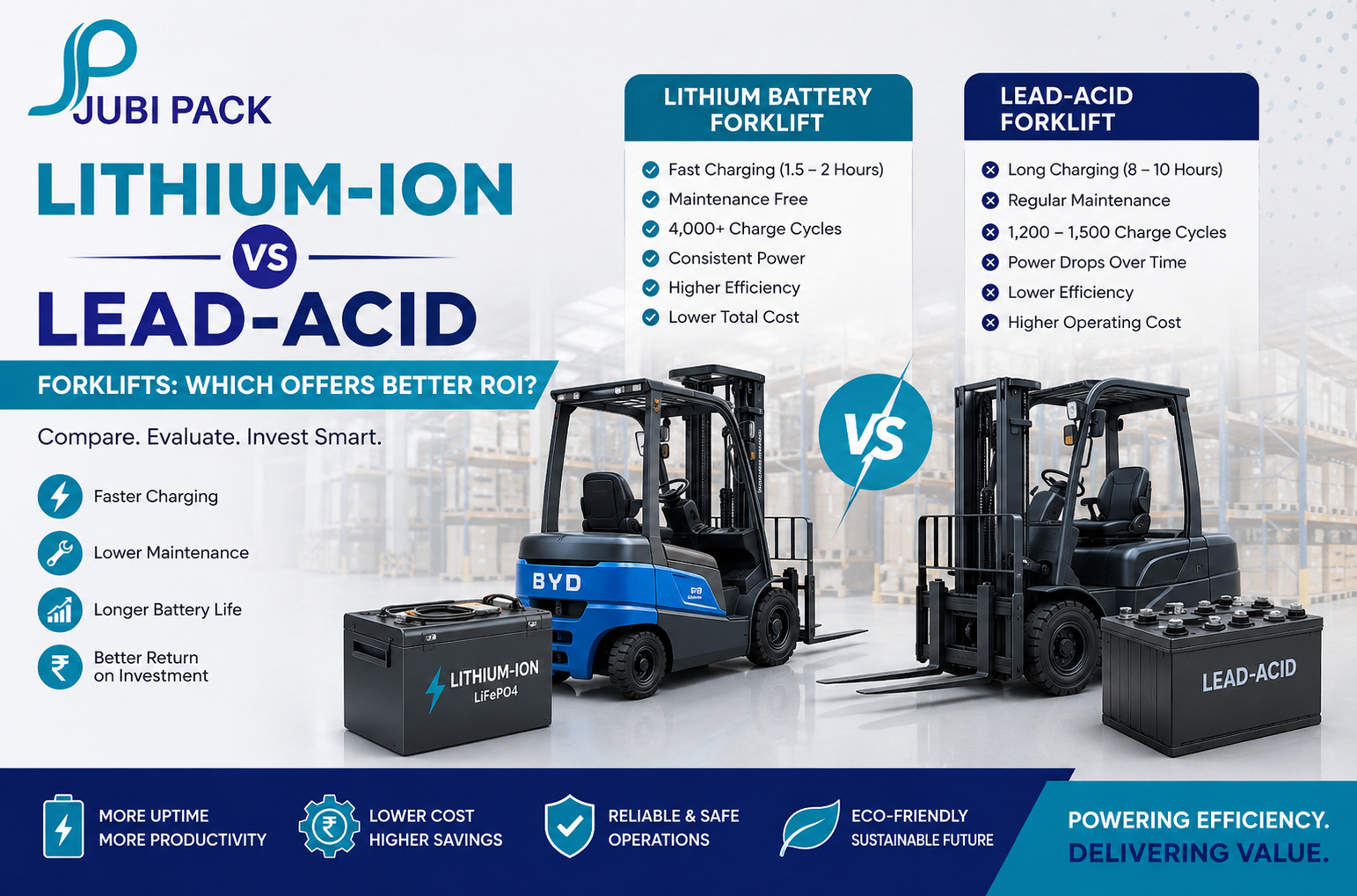
Lithium-Ion Vs Lead-Acid Forklifts: Which Offers Better ROI?
Choosing the right forklift battery is no longer just about powering your equipment—it's about maximizing productivity, reducing operating costs, and improving long-term return on investment (ROI). As warehouses, manufacturing facilities, and logistics companies continue to modernize, the debate between lithium vs lead acid forklift technology has become increasingly important.
Traditional lead acid forklifts have powered material handling operations for decades, but they come with challenges such as lengthy charging times, frequent maintenance, battery replacements, and performance drops during extended shifts. In contrast, the modern lithium battery forklift has revolutionized warehouse operations by offering fast charging, maintenance-free performance, longer battery life, and lower total ownership costs.
This comprehensive forklift battery comparison explores the differences between lithium-ion and lead-acid forklifts, helping businesses determine which option delivers the best ROI while supporting efficient warehouse equipment operations.
Understanding Forklift Battery Technologies
Forklift batteries are the heart of electric material handling equipment. Their performance directly affects productivity, energy consumption, maintenance costs, and equipment lifespan.
Lithium Battery Forklift
Lithium-ion forklifts use Lithium Iron Phosphate (LiFePO4) batteries that provide:
- Fast opportunity charging
- Maintenance-free operation
- Longer service life
- Stable power output
- High energy efficiency
- Zero emissions
These batteries are designed for businesses that require continuous operation across multiple shifts.
Lead Acid Forklift
Lead-acid batteries have been widely used for decades and remain common in budget-conscious operations.
They typically require:
- Regular water refilling
- Battery equalization
- Dedicated charging rooms
- Cooling periods
- Frequent maintenance
Although the initial purchase price is lower, long-term operating expenses are considerably higher.
Lithium vs Lead Acid Forklift: Key Differences
1. Initial Investment
Lead-acid forklifts generally cost less upfront, making them attractive for businesses with limited budgets.
Lithium battery forklifts have a higher purchase price due to advanced battery technology. However, this investment often pays for itself through lower operating costs, reduced maintenance, and increased productivity over time.
When evaluating ROI, businesses should consider the total cost of ownership rather than the initial purchase price alone.
2. Charging Time
Charging efficiency significantly impacts warehouse productivity.
Lithium Battery Forklift
- Full charge in approximately 1.5–2 hours
- Opportunity charging during breaks
- No cooling period required
- Ready for immediate use
Lead Acid Forklift
- Charging time of 8–10 hours
- Additional cooling period
- Often requires spare batteries for multiple shifts
Fast charging allows lithium forklifts to remain operational throughout the day, reducing downtime and increasing productivity.
3. Battery Life
Battery lifespan directly influences replacement costs.
Lithium Battery
- 4,000–5,000+ charge cycles
- Service life up to 8–10 years
- Consistent performance throughout battery life
Lead Acid Battery
- Approximately 1,200–1,500 charge cycles
- Replacement required every 3–5 years
- Performance gradually declines over time
The longer lifespan of lithium batteries significantly improves long-term ROI.
Maintenance Requirements
Maintenance costs are often underestimated when purchasing warehouse equipment.
Lithium Battery Forklift
Requires virtually no routine battery maintenance.
There is:
- No water refilling
- No acid checks
- No corrosion cleaning
- No battery room maintenance
Lead Acid Forklift
Requires regular:
- Water topping
- Terminal cleaning
- Acid monitoring
- Battery equalization
- Ventilation systems
These ongoing maintenance activities increase labor costs and equipment downtime.
Energy Efficiency Comparison
Energy efficiency directly affects operating expenses.
Lithium batteries convert a higher percentage of stored energy into usable power, resulting in:
- Lower electricity consumption
- Less heat generation
- Reduced energy waste
- Lower utility costs
Lead-acid batteries lose more energy during charging, making them less efficient for continuous warehouse operations.
For businesses operating multiple forklifts, improved energy efficiency translates into substantial annual savings.
Productivity and Performance
Warehouse productivity depends on uninterrupted equipment performance.
Lithium Battery Forklifts
Offer:
- Constant lifting power
- Consistent travel speed
- No voltage drop during shifts
- Quick charging between operations
Lead Acid Forklifts
Typically experience:
- Reduced performance as battery discharges
- Longer downtime
- Battery swapping
- Lower efficiency during extended shifts
A lithium battery forklift ensures continuous productivity throughout the working day.
Safety and Workplace Environment
Modern warehouses prioritize employee safety and environmental responsibility.
Lithium battery forklifts provide:
- Zero harmful gas emissions
- Minimal heat generation
- No acid spills
- Cleaner charging process
- Improved indoor air quality
Lead-acid batteries generate hydrogen gas during charging and contain corrosive acid that requires careful handling.
Choosing lithium batteries contributes to safer and healthier warehouse environments.
Total Cost of Ownership (TCO)
Return on investment should always consider total ownership costs.
Lithium Battery Forklift
Lower costs through:
- Minimal maintenance
- Lower electricity consumption
- Longer battery life
- Less downtime
- Higher productivity
Lead Acid Forklift
Higher expenses due to:
- Battery replacements
- Maintenance labor
- Spare battery purchases
- Charging room infrastructure
- Lost productivity
Although lithium forklifts require a higher initial investment, they generally provide lower lifetime operating costs.
Which Industries Benefit Most from Lithium Battery Forklifts?
Several industries have rapidly adopted lithium-powered warehouse equipment.
Warehousing
Fast charging supports continuous inventory movement.
Logistics
Improves fleet availability and reduces operating costs.
Manufacturing
Supports uninterrupted production lines.
Pharmaceutical
Provides clean, emission-free indoor operation.
Food Processing
Ideal for hygienic environments requiring zero emissions.
Retail Distribution
Increases loading and unloading efficiency.
Cold Storage
Lithium batteries maintain better performance in low-temperature environments compared to lead-acid batteries.
ROI Comparison: Lithium vs Lead Acid Forklift
| Feature | Lithium Battery Forklift | Lead Acid Forklift |
|---|---|---|
| Initial Cost | Higher | Lower |
| Charging Time | 1.5–2 Hours | 8–10 Hours |
| Maintenance | Minimal | High |
| Battery Life | 4,000–5,000+ Cycles | 1,200–1,500 Cycles |
| Opportunity Charging | Yes | No |
| Downtime | Very Low | High |
| Energy Efficiency | Excellent | Moderate |
| Environmental Impact | Zero Emissions | Acid & Gas Emissions |
| Total Ownership Cost | Lower | Higher |
| Long-Term ROI | Excellent | Moderate |
How to Choose the Right Forklift Battery
When selecting between lithium and lead-acid technology, consider:
- Number of operating shifts
- Daily operating hours
- Warehouse size
- Maintenance resources
- Electricity costs
- Future business growth
- Sustainability goals
- Total ownership cost
Businesses operating one or more shifts typically recover their lithium battery investment through lower operating expenses and increased productivity.
Future of Warehouse Equipment
The future of warehouse equipment is increasingly powered by lithium-ion technology.
Growing trends include:
- Smart battery monitoring
- IoT-enabled fleet management
- Predictive maintenance
- Automated warehouses
- Sustainable logistics
- Zero-emission operations
- Energy-efficient material handling
As businesses continue investing in automation and sustainability, lithium battery forklifts are becoming the industry standard.
Conclusion
When comparing lithium vs lead acid forklift technology, the long-term financial and operational benefits clearly favor lithium-ion batteries. Although lead-acid forklifts offer a lower initial purchase price, their higher maintenance costs, longer charging times, shorter battery life, and lower energy efficiency reduce overall ROI.
A lithium battery forklift delivers faster charging, maintenance-free performance, longer service life, improved productivity, and lower total ownership costs. For businesses seeking reliable warehouse equipment and a future-ready material handling solution, lithium-ion forklifts provide the best value and long-term return on investment. By evaluating operational needs, battery lifespan, and lifetime costs, companies can make a smarter investment that supports sustainable growth and efficient warehouse operations.